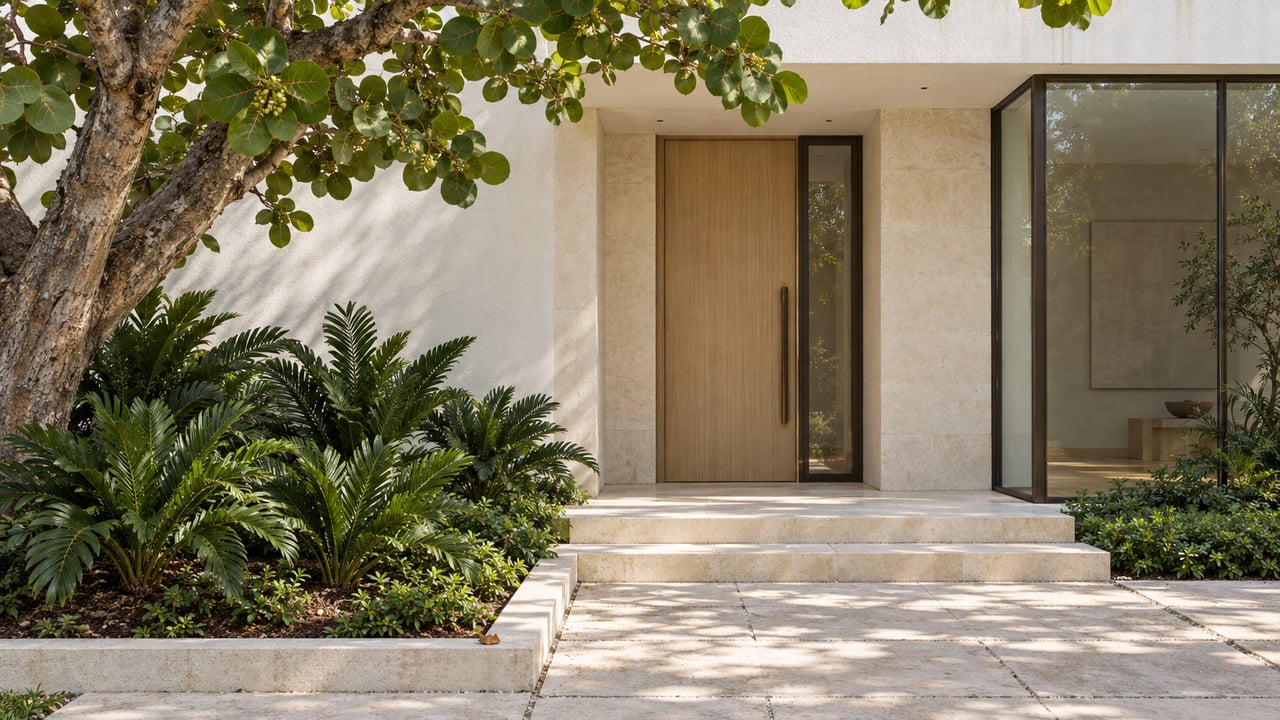
The Real Cost of a Coral Gables Renovation Starts Before the Contractor Ever Bids
October 1, 2026
October 1, 2026
On October 16, 2025, five items came before the Coral Gables Historic Preservation Board at City Hall on Biltmore Way. One was a straightforward request: expand a backyard gazebo on a landmarked property at 5005 Hammock Park Drive by half again its allowed size. Another was more tangled. The owner at 607 University Drive wanted local historic designation and design approval for a series of additions and site changes in the same meeting, a sequence that normally runs the other way. A third property, a 1920s house on Lisbon Street in the Granada section, came up for evaluation as a potential landmark, the kind of designation that has been rising steadily in that neighborhood as owners use it to head off teardown pressure.
None of this made headlines. It is the routine business of a board that meets monthly and will meet again next month with a different docket and the same set of rules. But if you are shopping for a house in Coral Gables and comparing it against a similar-looking listing in Coconut Grove or Pinecrest, this board is doing something to the price you are seeing that a portal listing will never show you.
Coral Gables enforces its Mediterranean Revival look through two separate review bodies, and which one applies to your future renovation depends entirely on whether the specific property carries historic designation, not on how old it looks.
Non-designated properties go through the Board of Architects for any exterior change: paint color, roofing material, additions, fences, pools. Designated landmarks and homes that contribute to one of the city's historic districts go through the Historic Preservation Board instead, which requires a Certificate of Appropriateness and evaluates the work against the Secretary of the Interior's Standards for rehabilitation. Interior work that never touches the exterior envelope skips both boards and goes straight to a standard building permit.
| Scope of work | Review body | Typical timeline |
|---|---|---|
| Interior renovation only | None, standard building permit | Plan check at Building & Zoning |
| Exterior change, non-designated home | Board of Architects | 3 to 8 weeks per cycle, often 2 to 4 cycles |
| Exterior change, designated landmark or contributing structure | Historic Preservation Board, Certificate of Appropriateness | Staff-level approvals in weeks; board-hearing projects run 6 to 12 or more weeks |
The distinction matters because age alone does not put a house in the second row. A 1950s house that never got local designation, no matter how charming, still runs through the faster Board of Architects track. A 1920s house that does get designated, like the one under review on Lisbon Street, moves into a slower and more procedurally involved lane the moment that designation is approved.
The Board of Architects meets twice monthly, and submittals are due roughly three weeks ahead of each session. A packet needs drawings, material samples, color samples, and a written narrative explaining how the design conforms to the Mediterranean Revival vocabulary the city has protected since George Merrick platted the community in 1925. Most projects need two to four submittal cycles before final approval, since the board routinely requests revisions on the first pass, particularly for new construction and larger renovations.
Historic Preservation Board timelines split further. A minor, in-kind repair, like patching stucco or replacing tile with a matching profile, can often clear at the staff level in a matter of weeks. Anything involving additions, demolition, or a major exterior remodel usually needs a public hearing, and that adds six to twelve weeks or more once notices and any variance requests are factored in.
Then there is the rule that catches people who think they are only replacing a few windows. Under the city's code, tied to Miami-Dade's High-Velocity Hurricane Zone requirements, replacing more than a quarter of a home's glazed area within a twelve-month period means every window in that scope must be impact-rated, carrying a Miami-Dade Notice of Acceptance. A project that started as "let's fix the three windows that leak" can turn into a full-house glazing upgrade once that threshold is crossed, and on a historic property the replacement units still need to preserve the original proportions and muntin pattern to pass review.
None of this is unusual by Coral Gables standards. It is simply not visible on a listing sheet, and it is exactly the kind of cost a buyer comparing square footage and asking price across neighborhoods has no way to see.
Coral Gables single-family pricing in the first quarter of 2026 averaged somewhere between $900 and $950 per square foot citywide, but that average hides how differently the segments behave. Non-waterfront new construction traded between roughly $1,100 and $1,300 per square foot, while ultra-prime waterfront enclaves like Gables Estates ran from $1,300 well past $3,000 per square foot.
That waterfront premium has not held steady. It has widened. In 2016, Gables Estates traded at around $1,185 per square foot against an east-of-US1 inland resale figure near $456, a gap of roughly 2.6 times. By 2026, Gables Estates had moved into the $2,500 to $3,500 per square foot range while inland resale sat closer to $1,050, pushing that multiple to roughly 3.0 times. The endpoints are directly measured; the years in between are a modeled arc, but the direction is not in dispute. Waterfront and turnkey inland has pulled further away from everything that still needs work.
You can see the same split play out in individual sales this year. 2500 North Greenway Drive sold for $5.25 million in less than a day. 1212 Sorolla Avenue, a house on a 22,500 square foot lot just north of Granada Golf Course, closed in January 2026 for $7.8 million in about a week. Both were turnkey, both sat on well-established residential streets, and both moved before most buyers had time to schedule a second showing.
Set that against the citywide averages for the same stretch of 2026. Over the three months ending in June, Coral Gables homes took a median of 99 days to sell, up from 85 days the year before, even as the median price per square foot climbed to $859. A market report on the 33134 zip code from April 2026 put average days on market at 140 and noted that roughly 30 percent of active listings had already taken a price reduction. Those numbers describe a market where the well-positioned, ready-to-occupy homes are moving in days and the homes that need exterior work, the kind that triggers a board submittal before a shovel goes in, are sitting for months and getting repriced.
That is the gap this piece set out to explain. It looks like a condition discount, the kind you would expect anywhere: outdated kitchen, deferred maintenance, knock some money off. In Coral Gables, part of that discount is condition and part of it is the buyer pricing in review-board risk, because whoever buys that house is also buying a multi-month, multi-cycle process before they can touch the roofline, the windows, or the color of the stucco.
None of this makes the older stock a bad purchase. It makes it a different kind of purchase, one that rewards a buyer who plans the sequence correctly.
The oolitic limestone used in original Merrick-era construction, quarried locally for foundations, walls, and garden structures, is not something you can source today. A house built with it carries a material history that a new build cannot replicate at any price. The 1950s and 1960s wave of construction that followed, built after the city's postwar growth, produced homes with large lots, solid structural bones, and mature tree canopy, several of them correctly renovated to modern mechanical standards while keeping the exterior in compliance. Those can be genuinely good value against a market that has priced ready-to-move-in homes at a growing premium.
The homeowners petitioning for landmark status on Lisbon Street illustrate the other side of that same coin. Local designation adds a review step, but it also protects a house and its immediate surroundings from incompatible redevelopment next door, which is part of why Granada has seen a steady rise in owner-initiated designations even as it adds friction to any future renovation.
The buyers who do well with a fixer in Coral Gables treat the review process as a pre-closing task, not a post-closing surprise. That means confirming a property's exact designation status, whether it sits in a historic district, carries individual landmark status, or has no local designation at all, since that single fact determines which board reviews any future exterior work and how long that review is likely to take. It means budgeting calendar time into the purchase itself, not just the contractor's bid, especially if the plan involves anything beyond in-kind repair. And it means understanding that interior renovation remains largely unrestricted regardless of a home's designation, so a buyer who wants to open up a kitchen or reconfigure bedrooms without changing the street-facing exterior has considerably more room to move than the process above might suggest.
Does buying an older Coral Gables home always mean a historic review? No. Local designation, not age by itself, is what triggers Historic Preservation Board review. Many properties that gained significance within roughly the past 50 years are generally not eligible for designation regardless of how they look. A non-designated older home with exterior changes still goes through the separate, and often faster, Board of Architects process.
Can I do anything to a Coral Gables house without board review? Interior renovations that do not alter the exterior envelope typically bypass both boards entirely and move straight to standard building permit review at the city's Building and Zoning Department.
What actually triggers the full window replacement requirement? Replacing more than a quarter of a home's total glazed area within a twelve-month window requires every window replaced within that period to carry a Miami-Dade impact rating, a rule that can turn a partial repair into a full-house upgrade faster than most renovation budgets anticipate.
If you are weighing a Coral Gables listing that needs exterior work against one that is already turnkey, that board timeline belongs in your offer strategy as much as your contractor's estimate. Melva Garcia can walk through what a specific property's designation status means before you write an offer, or how to sequence a listing if you are the one selling a home mid-renovation. Request a Concierge Consultation.
October 1, 2026
September 24, 2026
September 17, 2026

September 10, 2026
September 3, 2026
August 27, 2026
August 20, 2026
August 13, 2026
August 6, 2026
With years of combined knowledge in every aspect of the real estate industry – from negotiation and financing to selling and purchasing – Melva Garcia works to make the sale or purchase transaction a seamless and smooth experience.
MELVA GARCIA
[email protected]
(305) 491-4437
2550 S Bayshore Drive #106 Coconut Grove FL 33133 1515 Sunset Drive Suite 40 Miami FL 33143